
Reliable & fast asset finance in Australia
We’re a team of experienced asset finance brokers that help Aussie businesses get the equipment they need in less than 24hrs.
- 63+ lenders
- 24 hour turnaround
- Funding as fast as 8 hours
- No doc and low doc available
A quick guide to fast asset finance
It’s no secret that asset finance is essential for Australian businesses across every industry. From vehicles and machinery to technology and specialised equipment, it’s how businesses obtain the critical assets they need to secure new contracts, expand operations, and stay competitive. Every asset finance solution is tailored to match your business needs, industry requirements, and financial circumstances. Here’s an overview of our finance options. Please note that terms and rates may vary at the time of application based on market conditions and individual assessments.
Typical Loan Details
- 7yr Loan Terms Available
- 63+ lenders available
- Weekly, fortnightly, or monthly repayments
- Borrow up to $500k with a low doc loan
- Early repayments options
- Balloon payment options
- No deposit (even for non home owner)
- Assets across all industries in Australia
Calculate your asset finance repayments today
Feel free to estimate your rate, term, and deposit to get an idea of how much your repayments might be. Please keep in mind this is only to get a general idea and is not the calculator we will use to determine your actual loan repayments.
$495
$29,695
Supporting local Aussie businesses
Securing the right asset is a big deal and can make or break your business.
Our job is to cut through the noise, find you the right options, and close a deal quickly.
We work with local businesses like yours across Sydney, Canberra, Melbourne and Queensland. Whether you’re a tradie expanding your fleet, a transport company signing new routes, or a small business looking to upgrade your coffee machines, we’re here to make it happen.
Our team understands how important it is to ensure you get the best service possible, access to the right finance, and support throughout the whole process.
Unlike a home loan or personal loan, your access to asset finance will determine how fast you can grow your business.
Get in touch with our team today so we can guide you through the process and find the best deal on your business asset.
Your options at a glance
Finance structures compared
| Structure | Ownership | Tax treatment | Balloon | Best for |
|---|---|---|---|---|
| Chattel mortgage | You own the asset from day one; the lender holds a mortgage over it as security. | GST, depreciation and interest are generally deductible. Speak to your accountant. | Available | Businesses that want to own the asset from the start. |
| Finance lease | The lender owns the asset during the term; you have full use of it. | Payments may be deductible depending on your circumstances and business use. Speak to your accountant. | Residual payment to take ownership | Businesses that want to use the asset now and buy it at the end. |
| Commercial hire purchase | The lender owns the asset during the term; ownership transfers to you at the end. | GST, interest and depreciation are generally deductible. Speak to your accountant. | Available (final instalment) | Businesses that want to own the asset later, paid off in instalments. |
| Operating / rental lease | You never own the asset. You use it and return it at the end. | Payments may be deductible as an operating expense. Speak to your accountant. | Not applicable (you return the asset) | Short-term needs, or businesses that upgrade equipment often. |
What we need from you
| Item | Why we need it |
|---|---|
| Your name and contact details | So we can reach you and talk through the right option for your business. |
| Your ABN | So we can confirm you're financing through the business and match you with commercial lenders. |
| The asset type and price range | So we know which lenders actually fund that asset, and whether it's a no doc, low doc, or full doc application. |
| Whether you have a deposit, and when you need the asset | So we can structure the repayments around your cash flow and the date you need it. |

Get in touch with our team of Asset Finance Brokers today.
You can book a free discovery call with our team to learn about your options or simply submit an enquiry and we’ll call you back as soon as possible.
What are the pros and cons of a fast asset loan?
Cons
- Higher monthly repayments
- Responsible for maintenance costs
- Can still tie up some working capital
- Requires a good credit history for a good rate
- Insurance costs can be slightly higher
- Risk of negative equity if the equipment value drops
- Long-term commitment
- Easy to overcommit to new business
Pros
- Can own the asset outright from day one
- No deposit required (even for non-home owners)
- Tax benefits (GST, depreciation, interest, etc)
- Builds business equity & value quickly
- Possible balloon payment option to lower repayments
- Can grow the business without tying up capital
- Take on new customers or contracts faster
- Easier to forecast business growth and requirements
- Can access discounts through brokers
Our process
Learn about you
We offer discovery calls to learn about your business & asset finance requirements.
Compare loans
We’ll shortlist the best options for your asset and explain them to you.
Get pre-approved
We’ll secure pre-approval based on steps 1 and 2 so you have peace of mind.
Secure your asset
Found the exact asset you need? We’ll make sure you’re approved and the funds are available.
Why choose Stacked Finance?
Australia Wide
Our core team is based in Sydney. However, we support businesses all over Australia including Melbourne, Brisbane, Perth, Adelaide, Gold Coast, Canberra, and Newcastle.
Trustworthy
We believe integrity is the most important quality of a broker. Our team is honest and transparent about the options, fees, rates, timelines, and anything else you need to know.
24/7 Support
We’re committed to helping our clients. This means being available when they are. Most of our clients are busy running their companies – we ensure we’re available to support you when you need it most.
Let's talk loan details
- Up to $500,000
- Secured and unsecured
- 3, 5, and 7 years (depending on the age of the asset)
- Weekly, fortnightly, and monthly
- Fixed
- No deposit available up to $150,000, subject to your profile and the asset
- Generally up to 25 years at the end of the loan term
Our partners






















Book a free 20-minute discovery call
Not sure where to start? Feel free to book a call with our team to chat through your objectives. On the call, we’ll talk you through your business goals, asset requirements, processes, expected timelines, and anything else to help you make an informed decision.
What you’ll need to apply
Have these to hand and the application takes a couple of minutes.
- Your name
- Phone number
- Email address
- Your ABN
- The type of asset you are financing
- The price range you are looking at
- Whether you have a deposit
- When you need the asset, and how soon
What happens next
We read your application
We look at the asset, the amount and your business details.
We compare lenders
We shortlist the options that fit and explain them to you.
We come back to you
We talk you through what you can do and what it would cost.
You decide
Nothing moves forward until you say so.
Frequently Asked Questions
What is asset finance?
Asset finance is a funding solution that helps Aussie businesses acquire the equipment they need without tying up their cash. Instead of paying the full cost of the asset upfront, you can spread the expense over time, keeping your cash flow flexible and your business moving forward. There are four common types of solutions including chattel mortgage, commercial hire purchase, operating lease, and finance lease.
Am I eligible for asset finance?
Most Australian businesses (including sole traders) are eligible for asset finance!
We typically look for established businesses with a solid trading history, decent cash flow, and a clear plan for how the asset will increase your business performance. Lenders also need two years ABN and GST registration to be eligible for most low-doc and no-doc loans.
Whether you’re a small tradie in Perth or a growing SME in Sydney, we’ll find a financing solution that fits.
How fast can I get an asset loan?
Our process is designed for business owners who need things done quickly. Depending on your loan type, documentation, and asset type, we can turn around an approval in 24-48 hours. Once approved, funds can be released within a couple of hours.
Can you refinance an existing asset?
You can definitely refinance an existing asset but it will depend on the age, type of asset, the reason you want to refinance, the lender you’re with, and a few other factors. This is why it’s best to reach out to our team so we can help you reach your goals.
However, it’s worth considering how much interest you will need to pay, your monthly payments, and why you are refinancing.
How does asset finance work in Australia?
Getting asset finance is pretty simple and common in Australia.
Asset loans generally use the asset itself as security, creating a financing structure that benefits both the lender and the business owner.
The process typically involves three key structures in the Australian market:
Chattel Mortgage
- Most common for businesses to purchase equipment they intend to own
- You borrow funds to purchase the asset
- The asset serves as collateral for the loan (like a normal mortgage for a house)
- Tax benefits include potential GST input credits and depreciation claims
- Ownership transfers to you immediately upon purchase so the asset it on your balance sheet
Finance Lease
- Ideal for businesses that want flexibility and lower upfront costs
- The lender purchases the asset and leases it to your business
- Usually shows on the balance sheet as well
- Regular fixed payments over an agreed term
- At term’s end, you can either purchase the asset, return it, or refinance to a new lease
Hire Purchase
- Similar to a secured loan
- You agree to purchase the asset over time through installments
- Asset ownership transfers to you at the end of the term
- Typically used for equipment with predictable value and lifespan
Most businesses opt for one of the above methods because it has the following benefits:
- Preserves working capital
- Potential tax advantages
- Faster equipment acquisition
- Predictable budgeting through fixed repayments
- Flexible structure to match business cash flow
- ATO recognises these structures and allows potential tax deductions and GST benefits
Which types of assets can I finance with Stacked Finance?
The golden rule is simple: assets must serve a clear business purpose.
While that sounds straightforward, lenders have specific criteria about what qualifies.
They’re looking at the asset’s potential to generate value for your business. This means they want to know the value of the asset and the full use of the asset.
In addition, most lenders have stringent policies about the types of assets they’ll finance based on resale value. These are usually categorised as primary, secondary, or tertiary (in some cases category A, B, or C).
- Primary assets: These are assets with the highest resale value and are the easiest to sell. These usually include cars, trucks, trailers, excavators, heavy machinery, and other earth-moving equipment. These assets carry the most attractive rates and terms.
- Secondary assets: These typically include medical equipment, food, and manufacturing equipment. They have a resale value but are not as easy to sell as a car. These assets have slightly less attractive rates and terms since they have less value.
- Tertiary assets: These assets have little to no value in the marketplace and are not easy to sell. They can include things like a 25-year-old trailer or a POS system. Tertiary assets carry much higher interest rates and less favourable terms since they are a major risk for the lender to finance.
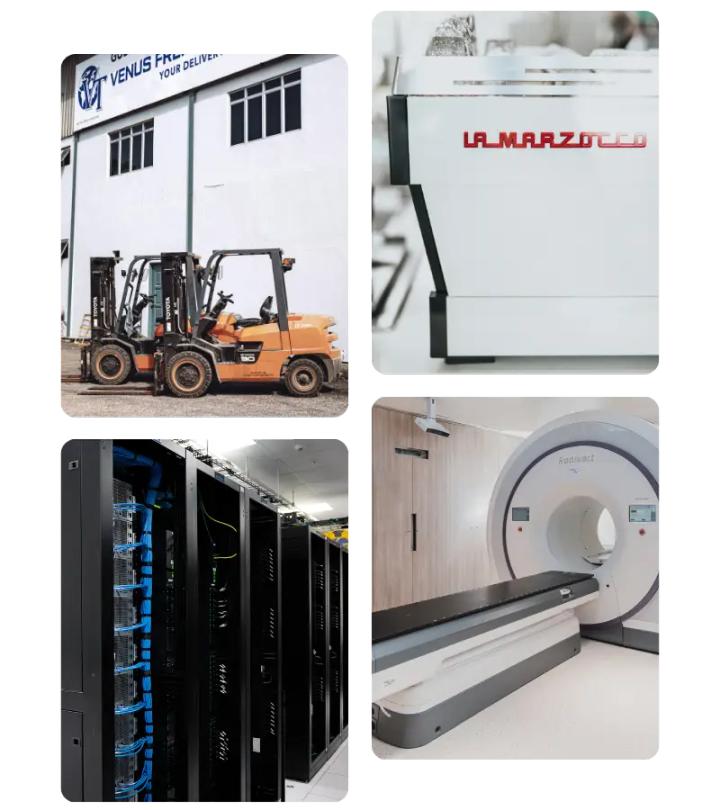
Here are some of the most common assets we finance for our clients:
- Commercial transport fleet (trucks, vans, etc)
- Earthmoving equipment (excavators, bobcats, etc)
- Aviation and other related aircraft (planes)
- Construction and agricultural machinery
- Medical equipment and beauty equipment
- Office equipment and IT infrastructure (servers, laptops, printers, etc)
- Precision manufacturing tools
- Marine equipment (boats, jet skis, etc)
- Industry-specific equipment
- Other equipment (coffee machines, pilates reformers, etc)
How can asset finance improve cash flow for my business?
Asset finance preserves your working capital by spreading the cost over time. Instead of a massive upfront payment, you make small and manageable monthly repayments. In some cases, you can opt for a higher balloon payment too which means you only need to pay a smaller lump sum at the end of the loan term. This means you can keep your cash to invest in the growth of your company, manage unexpected expenses, and keep your business agile.
How can I get the lowest monthly repayments for my asset loan?
Reducing your repayments comes down to a few core factors. Here’s what we recommend to our clients to keep costs low:
Loan term strategies
- Extend the loan term (more months = smaller repayments)
- Balance term length against total interest paid
- Consider 5-7 year terms for optimal flexibility
Deposit & upfront payment
- A larger initial deposit will always reduce the principal & result in less interest
- Lower borrowing amount means smaller monthly repayments
- Aim for 20-30% deposit if possible since you’ll also access lower rates (lenders like deposits)
Additional Tactics
- Choose assets with a strong resale value (Category A or Primary Assets have better rates)
- Negotiate equipment pricing before financing
- Consider residual payment structures (i.e. balloon payments)
- Compare multiple lender options
- Consider a full-documentation loan to access a better rate
Pro Tip: Don’t just chase the lowest repayment. The cheapest option isn’t always the most cost-effective long-term. A slightly higher repayment might save you thousands in total interest.
Our brokers will crunch the numbers and find a sweet spot between repayment size and overall loan cost.
Should I get an asset loan or should I purchase the asset in cash?
Unfortunately, we can’t offer financial advise, so this is something you will need to discuss with your accountant. However, here are some things to consider about getting an asset loan:
- You will retain a lot of working capital which is critical for all businesses
- There are often tax advantages associated with an asset loan
- The faster you can acquire the asset the faster it can earn income
Can I get an asset loan if I have a bad credit score?
Yes, just because you have a bad credit rating does not mean you are ineligible.
Our lending specialists will help you access the assets you need regardless of your credit score or credit history.
Please keep in mind that a bad credit score tends to attract higher interest rates and less favourable finance solutions. You may be required to provide additional information.
Please schedule a 20-minute discovery call with our team today to learn how we can help you.
Which other service do you offer?
Stacked Finance is focused on the commercial market as opposed to consumer. We classify all of our clients as business customers.
This means we only help Australian businesses obtain equipment loans/asset loans or business loans.
Whether you need a new asset like a truck, ute, trailer, or digger, we can help. Our team is also skilled at providing working capital loans, cash flow finance, unsecured loans, startup loans, or any other specific type of business-related funding.
Feel free to also use our calculators to get an estimate for what your repayments may be.

Need help with finance?
Send Emmanuel a message and he’ll get back to you shortly.
Or call Emmanuel directly on 0417 209 702